National Paintings
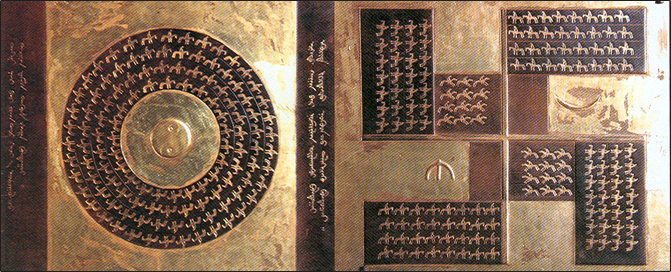
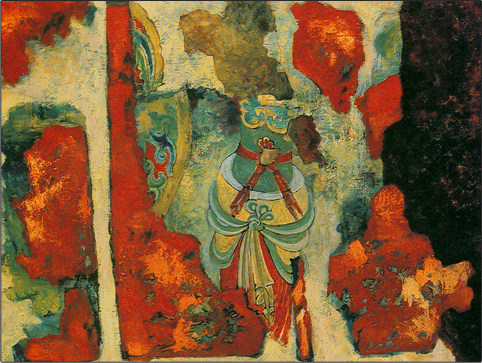
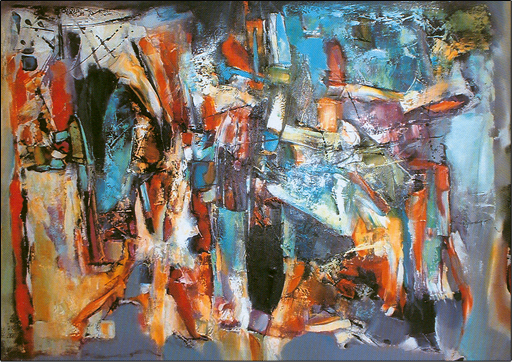
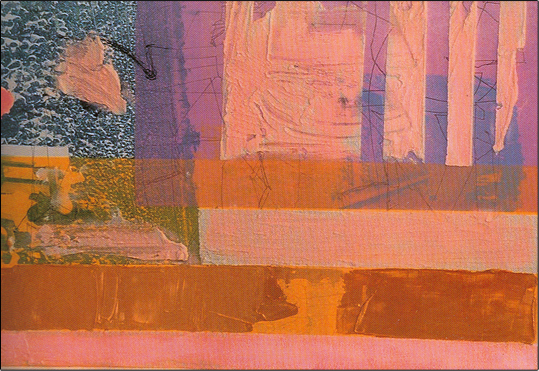
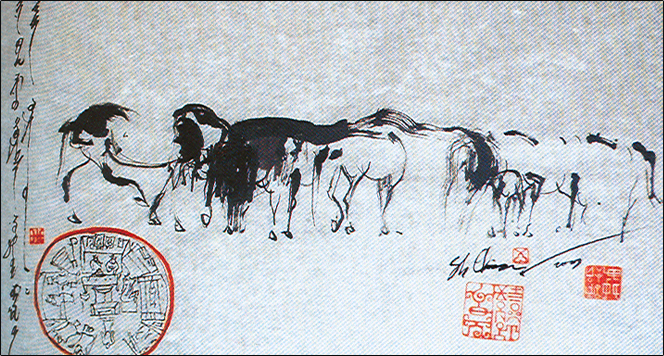
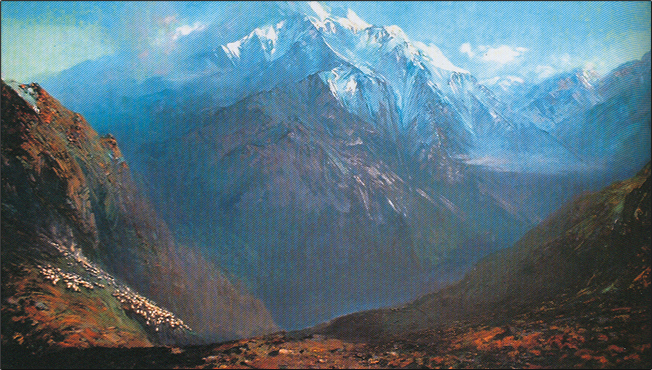
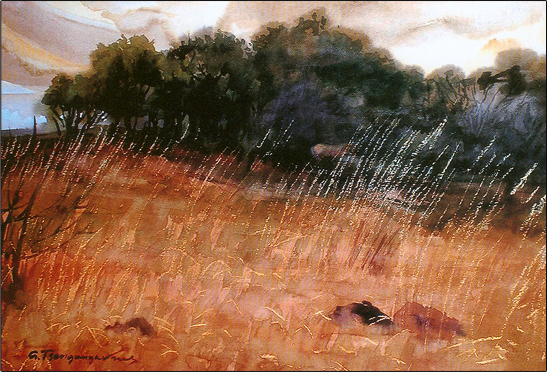
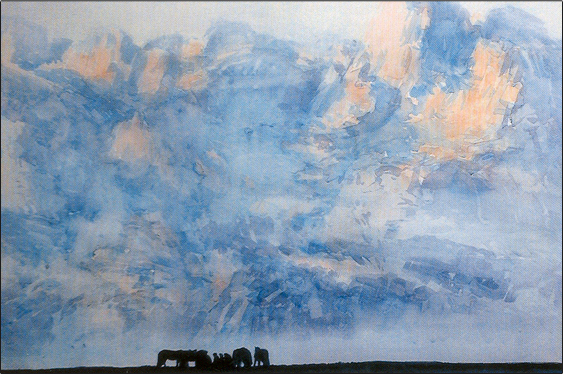
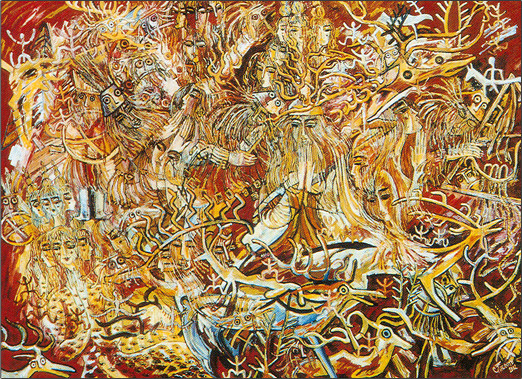
One of the major forms of Mongolian fine art that originated in hoary antiquity is painting. Petroglyphs depicting the "tamag" signs, deer, moose, wild argali sheep and other wild beasts, birds and domestic animals served as totems for tribes inhabiting the forests and steppes of Central Asia, as did petroglyphs reflecting the work, hunting and beliefs of the ancient hunters and cattle breeders. Examples can be found throughout the country.
Prehistoric artists used very durable techniques: they either carved silhouettes on the rock surface or painted the figures in predominantly red pigments from mineral ore. To cite just one example: a felt carpet of the Huns, excavated from the Noyon Uul burials, gives a vivid idea of the Hun imitative art. The 2.6 m by 1.95 m carpet was found in the sixth grave. Its center is filled with an uninterrupted line of horn-like design and is framed by nine pairs of stylized fighting animals. One of the stylized pairs shows a shaggy sarlag, or yak, with pointed horns butting a panther that is clawing at him. Another pair is an infuriated vulture with its beak and claws digging into the hindquarters of a fleeing deer. These compositions are rendered in applique and are separated from each other by schematically treated branchy green trees, also in applique. And this genuinely artistic and expressive, and at the same time ironic, depiction of beasts fighting for survival on a Hun carpet can be considered not as merely decorative craft, but also a wholesome work of fine arts. The author's perfect knowledge of the beasts' anatomy, characteristic behavioral traits and his command of hyperbola and expressiveness are obvious and one could very well conclude that through these fighting animals he intended to convey the inter-tribal wars and the victory of the Huns. This magnificent creation of the Hun craftsmen testifies to the continuity of the "stylized animal" art that predominated in Central Asia and originated in the Bronze Age.
The symmetrical composition, rhythm, distinctive color combinations and the entire figurative reproduction give a vivid idea of the artistic side of the fine arts in that distant past.
In the 1 st and 2nd centuries AD the Mahayana branch of Buddhism penetrated into Mongolia via the Silk Road, which spread during the Kushan rule that controlled the north of India and Central Asia. Uigur (8th century AD), the most Buddhist of all states and a prosperous one at that, which existed in the territory of Mongolia, had a concrete influence on the artistic culture of the Mongolian nation. During the excavations conducted by a Mongolian-Soviet expedition in 1946-47, pieces from part of Buddhist temples with fragments of wall-murals on them were dug out from Ogedei Khan's palace of "A Thousand Tranquilities." Scientists attribute these murals to a number of schools of the Uigur and Central Asian painting of the 9th10th centuries AD. Dal-Lyao, a Mongolian-speaking state of the Kidans, existed for two hundred years in the 10th and 11th centuries. It maintained broad relations with China, Korea and countries of Central Asia. It boasted of prospering portrait and landscape genres and wall-murals on historical subjects.
Of considerable interest are wall-murals of a temple found by Japanese archaeologists in 1932 near the Tsagaan Stupa in Inner Mongolia. A row of men, armed with bows and arrows, is painted amidst Asian-looking figures. Their attire, facial features and posture apparently testify that they are Mongolians. The manner of the drawing is realistic, soft and sure with accurate observance of the characteristic proportions of the body.
The Khangai landscape in eastern Mongolia, in four seasons, as well as the animal and bird kingdoms of that place are depicted on the murals. By its manner and form of execution, this mural is essentially different from the Tang and Sung landscapes. It contains perfectly balanced depictions of mountains, rivers and forests, deers and antelopes in the taiga and birds on tree branches. The clouds, floating in distance, are rendered in rich shades. The entire landscape, very much resembles works in Mongol Zurag style of later period.
According to historical sources, from among the Kidan towns and settlements in the Mongolian territory, the most noteworthy among them was the Herlen Bars. And in this town there is a great deserted pagan temple with two pagodas near it. Buddha painted on the walls of these sevenstorey and five-storey pagodas have been preserved intact. In the 13th century, the Mongolian conquerors did not confine themselves to the strengthening of their states only but also established their protectorate over numerous countries in the East and West. They brought back craftsmen from those lands to Karakorum, where the lavishly decorated palaces and temples were built. For instance, the portraits of the Yuan rulers were in the Ancestor's Temple in Beijing. They could possibly be viewed as Mongol Zurag productions with Central Asian art influence.
These paintings are the direct continuation of the Kidan portrait and artistically bear a profound depiction of the ancient Mongolian aristocracy. Judging by the attire, the outfit and the jewellers of the personages painted, they fully coincide with the descriptions in historical sources and travellers' notes, which evidently leads to the conclusion that the artists were contemporaries of the portrayed Khans and their wives and their works - portraits of real historical individual.
Paintings from the Topkapi Museum in Istanbul, Turkey, reproduced in a book "Mongolian Painting," give a realistic idea of ancient Mongolian painting. Some of them show the life of the nomad cattle-breeders, rearing of horses and other domesticated animals, hunting scenes portraying various wild beats in full motion. While other paintings depict zoomorphic creatures, strong and savage, clad in human attire with bracelets around their wrists and ankles. These supernatural monsters are depicted as human beings, wrestling with each other, stealing horses, dancing and makinq music. The maior personaqes and themes of Mongolian paintings of those times were giants from heroic epics, battle scenes, the feats and triumph of the khans and noyons (feudal princes), and similarly popular were landscapes and animalistic. The carefully weighed composition, depictive manner and movements of personages are striking for their originality and especially for their daring and free monumentality that fundamentally distinguish them from the local miniatures. This manner of painting is obviously of a realistic nature, the pictures are in relief and the shades predominantly red, blue and brown. Thus, prehistoric and medieval states, with brilliant and unique culture, which prospered at different times in the territory of Mongolia, left behind themselves rich artistic heritage and it would be impossible to create a complete and realistic picture of the ancient Mongolian painting without taking them into consideration.
Folk Painting
The priceless treasure-house of folklore, songs, music, dance, theatrical art and handicrafts through which the Mongolian people described their everyday duties, dreams and hopes, also includes a unique style of folk painting. Such paintings were not subject to official canon, they did not cross the threshold of magnificent palaces and temples, but thrived among the people, in the gers of ordinary livestock-breeders. Their sphere of value was wide. People made guess-work on them, involving the four cardinal points, planets and stars, and depicted the spirits - masters of the land and water and shaman tengris. There also existed other forms, such as Uichuur, playing cards and book illustrations. Spirits - the masters of earth or a given locality - were depicted with spears and lassoes raised overhead, accompanied by black dogs and messenger crows and hawks, resembling to a certain extent fine fellows from fairy tales.
Particularly appealing in this genre are small-size paintings meant for various card games. Since olden times there existed among the Mongolians such games as Hozor (playing cards), Uichuur and the like. They were not printed but were hand-painted, on account of which every single card in itself was a testament to the skill of the painter and in this respect playing cards represented a very interesting branch of folk painting. Uichuur is a game with cards bearing illustrations of almost 130 animals of seven species, one on each card, starting from 64 birds with a value of one Lang each and ending with a single 64-Lang lion. The players threw dice and collected Langs according to the points. Besides having talent and a keen eye for observation, the painter also had to have much imagination in order to depict so many animals some of which didn't even exist in reality. For instance, each of the 64 different birds, from common sparrows to peacocks, parrots, vultures, eagles, Garuda, etc., were painted clearly and distinctly showing characteristic appearance and movement. Similarly were depicted 32 rabbits, 16 deer and other animals. These animal images were acompanied by attributes in the form of spirits of earth and water, good and evil forces of fate, thanks to which the drawings can be considered as a kind of reflection of the disposition and world outlook of the people of that past period.
Mongolian playing cards differed from European ones and were distinguished by a unique way of depicting the kings, queens and jacks. The six suits of Mongolian playing cards were hearts, spades, clubs, diamonds, tips and half-moon.
Today such old playing cards are still found in some regions in Khovsgol, Arkhangai and Zavkhan aimags (provinces). While drawing them, the artists did not confine themselves to any stencil or established pattern, so every playing card had a free subject and idea. For example the king of clubs in the pack at the Museum of Fine Arts in Ulaanbaatar shows two personages, sitting facing each other. One of them; a prince with trimmed black whiskers in a round cap with a jins and a plume of peacock feathers, is depicted en face sitting on a chair and holding in one hand a smoking pipe. The other personage is an official with a long black plait, holding a snuff-box and wearing an ordinary four-sided cap trimmed with fur. Apparently, these two gentlemen have just sat down and according to Mongolian custom are treating each other to a smoke before striking up a conversation. Judging by their faces and outward appearance, the personages are taken from an epic and as it says:"...the faces icy cold, cruel, whiskers like saws, their hearts know not fear and their souls know not mercy. . . " . On another card is depicted a privileged lady with a beautiful gold grip in her hair, dining by a tall table with flowers. She is shown holding chopsticks with slender white fingers. A slim maid-servant is obediently standing in front of her. Judging by everything, this is the queen of the aforementioned king of clubs.
The museum of local lore in Galt soum (district) in Khovsgol aimag has round-shaped playing cards with interesting images. They show family scenes: the queens of diamonds and hearts are sitting half-turned in the forefront on thick felt mats and quarrelling with their husbands, sitting behind them with arms akimbo. The queen of half moon is shown sitting on a mat and behind her a servant playing a reed flute. Another shows a noyon (feudal prince) sitting on a tall chair dressed in ceremonial vestment, in dark semi-kaftan and headgear with jins and plume, leaning on his left arm and making vigorous gestures with his right hand, holding a smoking pipe, conceitedly ordering an obedient servant kneeling before him. The queen from the pack of cards found in Arkhangai aimag depicts a lady going together with children. This lady seems to be embarrassed at the passes made at her by an officer but at the same time she smiles secretly, not without predilection for courting. The aces from this pack are unique. The ace of diamonds bears the image of a dragon flying through a cloud. In the lower left are shown a lama (Buddhist monk) with a promissory book in hand, sitting solemnly on a multi-layered mat and an official conducting an investigation. In front of them are three tiny figurines. Investigation is underway. One of the kneeling figures with tied hands is being beaten on the cheek, blood oozing out.
The most remarkable in this pack of playing cards is probably the jack of tips, showing an arduous work of a blacksmith. To the right is an old blacksmith kneeling on a raw hide and holding with a pair of tongs the red-hot iron on an anvil. With a hammer in his right hand the old smith is ready to forge. Opposite him is portrayed a young man with bare chest and soiled face, fanning the iron with bellows. Show are also instruments necessary for a blacksmith, such as a knife for cutting iron, water in copper bowl as well as ready-made articles like steel, folding knife, bits, trap, tripod, etc. On the upper part of the card there is a partially obliterated inscription "Blacksmith Bat-Ochir". If we carefully examine these playing cards, passed on from one hand to another, we can see that they are miniature works of art, graphically depicting secular scenes and episodes from everyday life. An anonymous artist was able to see them and imprint them on the card. These works remind of the inspired art of narrators, rhapsodies, who seemed to be amusing the listeners with their improvisations but in fact glorified this and criticised that, dwelling upon all that their eyes saw and their mind comprehended.
The artist was an eyewitness of the life he portrayed and personally knew his subjects. Hesympathised with one, and ridiculed and scoffed at others and depicted them with high accuracy and resourcefulness. His works represented the most popular and accessible art, through which he criticised the feudal-clerical institutes and expressed his protest, thus marching with the times and through his work taking part in the solution of urgent social problems.
These paintings are simple in shade, composition and drawing techniques. The central figure is located in the centre or in a visible place, prominent and free of unnecessary detail. Nonetheless the picture does not miss the necessary elements that serve to reveal the key idea and characterize the image. To note to the point, these miniature drawings were replete with genuine artistic vigour, charm, spontaneity of feeling, so lacking in classical painting and appliques, which had reached considerable heights in composition, colour and technique. But they had been confined within the canon and therefore deprived of freedom of development.
There were numerous training aides with a considerable number of vivid illustrations on botany, medicinal herbs, zoology, mathematics, astrology, astronomy, medicine, the anatomy of human body, acupuncture, surgery, etc.
Although such pictures lacked the figurative vigour characteristic of the aforementioned playing cards, they nevertheless should not be denied expressiveness.
Besides book illustrations, in the Tibetan-Mongolian area there existed a set of paintings, although genetically linked with religion, but widespread among the masses and highly symbolic, such as "The Four Amicable Friends" (Tumbashi), "The Six Long Years" (Tserendug), "The Four Most Powerful Ones", "The Seven Priceless" and so on. The main hero of the painting "Dugar Zaisan", originated presumably from Western Mongolia and is depicted in the form of a Mongolian epic hero with bow and arrow, wearing a headgear decorated with jins and plume and taming a bars -snow leopard.
The art of ornamentation, part and parcel of the Mongolians' aesthetic values, should also be attributed to folk painting. Folk artisans created various intricate patterns with hidden symbolism, splendour of colour and much intertwinement and conversions, starting from plant designs (various forms of flowers, leaves, petals) to zoomorphic motives of stylised horn, head and hoof. There were ones reproducing natural phenomena (waves, fire, clouds, trees, cliffs) as well as geometrical patterns (meander, Ulzii, Tumen Nasan (Thousand Lives), King's Bracelet, Queen's Earrings, etc.).
Iconography
The fall of the Yuan empire ushered in the most grim period in Mongolian history, marked by endless turmoil, wars, political and economic downfall and immeasurable suffering on the part of the people. Ancient towns with their architectural, cultural and artistic monuments died away and Mongolia once again became a deserted steppe.
This was a time when the once-flourishing states of the Middle East and Central Asia succumbed to Islam and the numerous, once-prospering Buddhist temples and monasteries were destroyed and buried under dirt. But the Yellow Sect of Buddhism (Lamaism), which had firm foothold in Tibet, was given the opportunity to freely penetrate and spread in Mongolia. This sect was a combination of Sutrantics and Tantrism, reformatically blended by the Amdo lama Zonhava (1354-1419) with due regard for Tibetan specifics.
Religious cults, rites and especially iconography under-went notable changes, which were complied with until recent days. And iconography, which spread in Mongolia, should be attributed to the Tibetan school of painting.
From early times, Mongolian artists were closely acquainted with the ancient Indian science of art, the techniques and the canonical rules observed in depicting a human being. Moreover, they had access to textbooks written by Lama Ishbaljir (1704-1788), Lama Agvanhaidav (1779-1838) and Agvantseren and other lama artists, which served as significant means for raising the painters' skill. In iconography, an important place belongs to the science of proportions, whose traditions go back to the ancient Indian doctrines of Pratimalakshana, Chitralakshana, the most authoritative being Kalachakra and Samvara scripts. In iconography, there are ten proportion modules, their primary units being the palm and the fingers. Mongolians, in painting tranquil Buddhas and Bodhisattvas, used a ten-palm module or a harmonic system of dashtala, and used an inferior system of ashtatala, that is a proportion pattern of 6-8 palms, while depicting the Dharmapalas and sahius - custodians. The human body is reproduced with the help of nine vertical, twelve horizontal, and six diagonal lines. In drawing the face, the artists used four horizontal lines, marking the temple, the point on the forehead where hair grows, the tip of the nose and the chin. These lines were connected by two diagonal lines of the left and the right cheeks, another two of the right and left ear-lobes, all in all four diagonals. The correctly placed lines, equal to ten-palm or 120-finger module, has a definite affinity with the classical European proportion of depicting a man, determined by the great Leonardo da Vinci and Albreht Durer. Although Mongolian painters theoretically relied on Indian sutras and doctrines, in practice they were guided by Central and East Tibetan iconography of the 14th century.
There were xylographic handbooks: the "Collection of 300 Burhans," which included canons for depicting main tantric deities, and the "500 Burhans," published in 1811 in Urga (the former name of Ulaanbaatar), jointly compiled by artists Agvansharav, Luvsanjamba, Luvsandash, Luvsanchoidog, Luvsantseveg and engravers Tserendash, Choirov, Choinjur and others.
The first Khalkh Javzundamba, G. Zanabazar, was a man of all-round learning and exceptional talent. It is not by chance that he was the founder of the Mongolian school of Buddhist art.
By creating the images of tranquil Buddhas and Bodhisattvas, he strove to create the image of deified human being, the mind fully concentrated on the subject of meditation and faultlessly proportionate in outward appearance. G. Zanabazar attained this goal, leaving behind brilliant examples of artistically perfect creations, embodying all the 32 and 80 qualities of the divine beauty. These are his Vajradhara, Dhyani Buddha etc. The pantheon of tantric deities, depicted by Mongolian iconographers, is exceptionally rich. The pantheon did not include realistic portraits of men but a collection of abstract imaginary, "pedantic" images of the Dharmas, meant for a visual understanding of the essence of the religious tenets, and therefore the artists had to confine themselves to a strictly established canon without exercising the right even to slightly modify it. Nonetheless, the Mongolian school of iconography founded by G. Zanabazar, which regarded these canons as means to depict and convey human beauty, is distinctive for its profoundly realistic portrayal of a human being. Admiring Zanabazar's White and Green Taras, one involuntarily feels the strength of the talent and the magic force of artistic gift, that enlivened the inert religious canon, thanks to which the bronze images of the goddesses with their divinely proportioned correlation of the parts of the body and its supple, gentle movements, are conceived as portrayals of mortal Mongolian women, blessing all with their love and gentle care.
The fierce Dharmapalas, though hyperbolized and over-expressive, and depicted in the image of giants which exhale flames from their sharp-fanged mouths or as terrible, many headed mangas - cannibals with gruesome faces and arms and legs protruding in all directions. They impress with their life-likeness and their finely coordinated proportions. The creative individuality and craftsmanship of the artists enjoyed certain freedom while reproducing the images of high-ranking lamas of their own lama-tutors. Such works by Zanabazar as "Self-portrait", "Mother's Portrait" as well as the portraits of the first and fifth Javzundamba, which were most likely executed by Agvansharav, a renowned Urga artist of the mid-19th century, are in a true sense masterpieces of the portrait genre.
The authors of the portraits, amazing for their refined lines and combinations of clear and bright shades having exhausted all possibilities offered by two-dimensional (fiat) painting, made a number of attempts in relief depiction.
Some hundred years later, painting caught up with the level reached by classical sculpture and artistic casting originated by G. Zanabazar in the 17th century, and from historical sources and chronicles it becomes clear that by the late 18th and early 19th century, there were quite a few renowned artists in Mongolia. The major sanctuaries produced in Urga during the lifetime of the fifth Javzundamba Luvsanchultemjigmid (1815-1841) alone, include more than 140 paintings - large-size icons.
The names of more than thirty renowned and widely-acclaimed artists who lived and worked in the latter half of the 19th century are known to us. For instance, the paintings "Gombo" and "Shalsha" by the artist Baldangombo, made in the late 1870s, and some of the depictions of geniuses by Tserendorj and Shirbazar are displayed at the Bogd-khan museum in Ulaanbaatar.
The Fine Arts Museum houses the "Jamsran" (Begze in Sanskrit) painted by Gendendamba, teacher of many Urga artists. "Jamsran's" color palitre, exquisite plasticity and harmonious movement make it a fine example of Mongolian painting. The personage (idam, like a hero in complete armour), stands regally and solemnly in front of its palace built of human bones in the center of raging flames.
Another brilliant work of Mongolian painting is "Jugdernamjil" (Author Jugder) also from the collection of the Fine Arts Museum. It differs from the previous painting by its subtleness and light colors, for it is painted predominantly in the shades of white jasper, which convey to the picture the material glow of this stone. Jugdernamjil is the goddess of longevity and has three faces: blue and yellow ones at the sides and a beautiful pale face of a young woman in the center.
Her eight arms, different in shape, are depicted as moving harmoniously and plastically.
These two paintings vividly show the differences in treating the images of tranquil Buddhas and Bodhisattvas and the fierce idams and sahius - the custodian geniuses.
For ages, Mongolian national traditional painting had been working out techniques for preparing primer, dye and other painting materials. The youth, eager to acquire the techniques, learnt from their elders. Silk or coarse cloth, stretched on a wooden frame with the help of cords, was used as canvas. In prime coating, arkhi (milk vodka) mixed with glue and chalk-dust was used. When dried up, it was smoothed by the polished part of solid and soft stones, rubbed in turn. As a result, the canvas became thick and smooth, capable of retaining paints for a long time. To avoid soiling and spoiling of the white canvas, the drawing was first transferred onto paper by puncturing the paper along the contour with a needle and then transferred onto the canvas by applying dry-dye along the punctured lines. The outlines were carefully pencilled, after which it only needed painting. As far as the paints were concerned, Mongolian artists made them themselves from mineral ores. The methods used in making paints were quite simple. For example, yellow dye was produced by soaking finely ground ochre in water for some time, and terracotta dye by burning ochre in a tightly covered vessel. The dye, when not sufficiently pulverized, produced a low-quality pigment tending to produce stripes; but perfectly processed, they yielded very durable paints with which any thin line could be drawn.
In Mongolia, the sun shining all year round made everything look clear and transparent and Mongolian artists also resorted more frequent to clear and definite shades, rarely using halftones.
Sumbe Hamba Ishbaljir, in his book "Garland of Flowers," wrote: "Ten Khokh (azure blue), nogoon (green), shonh (scarlet), engeseg huren (brown), khond (orange-red), shar (yellow) and aram khokh (Paris blue) were considered father-colours. The mother was white, because it was characteristically perceived to belong to every color. The sons were all resultant shades: light red, purple, yellow, green, light blue etc. 'The servant-colours were ash-gray shades with a touch of black with which witches, ghosts and other evil forces were depicted. The father and mother colors were highly respected and each of them bore a certain symbolic meaning; thus blue, on the analogy with the color of the sky, symbolized eternity and loyalty; yellow, because of its similarity with gold, meant wealth, love and spirituality; red - materiality and joy; white - sanctity, chastity, purity and virginity and black - danger, calamity and evil.
Among all works of decorative and applied arts, temple interiors, clothing and furniture, the most appreciated were the combinations of bright colors. For instance, on the white cover of the ger (round felt dwelling of the Mongolians) there frequently were special stripes of red cloth for decoration. Or a blue tent had designs of white cloth, or a black horse was put on a saddle with red pommel and green saddle-cushion.
Alongside mineral pigments, Mongolian artists made different paints from precious stones - turquoise, lapis lazuli, coral, pearl, mother-pearl - or from such metals as gold, silver, copper and iron. These pigments were widely used in painting, calligraphy and in book-decor.
To begin with, the surface was evenly covered with paints in a flat manner, then the relief and depth were attained and in the end the contours were rimmed with colorful lines and finally ornamented with gold. The lines by Mongolian artists were not as thin and straight as the hair, but they had an excellent command of the brush, skilfully using different techniques of painting, and their lines were dynamic and full of motion, thick in the middle and thin at both ends. Draperies, ribbons, hadaks (a long narrow piece of blue silk for presentation on formal occasions as a mark of respect), curves of leaves and flowers, tongues of flame, waves, smoke and clouds executed in this manner acquired impressive lifelikeness. Large figures were outlined by expressive and fine drawing, while the smaller figures, including those in the background, were reproduced with thin and subtle strokes. The auxiliary lines could be of different colors but strictly subject to the main color. There were interesting techniques of martan (mar-red) and nagtan (nag-black) which were different ways of painting with lines of various colors, obtained from the nine gems, on red or black background respectively. This remarkable skill of an artist-drawer is evidenced by the picture "Damdin" in the Fine Arts Museum.
The 19th century saw the rise of a kind of calligraphic art and book-decorum, which, like the nagtan technique, was the writing of a book in gold or the nine-gem colors on black sheet.
The tradition of artistic embroidery and applique, which originated from the aforementioned Hun felt carpet and which reached its peak of development during the Mongolian empire, were incessantly passed down from one generation to another, and in the 18-19th centuries came to compete with painting. This form of imitative arts represented itself by silk appliques. An icon executed in this technique was akin in its composition and shade to painting. Moreover, it looked much richer and resplendent because, instead of paints, colorful pieces of silk and brocade were used.
Urga school
Artistic culture during Lamaism served the requirements of the society of the given period, but by the turn of the 20th century was imbued with the idea of struggle for freedom and independence. Among all fine-art genres, painting was more sensitive to the call of the time. And the artists, earlier engaged in making icons and appliques, now started energetically working on paintings on social themes.
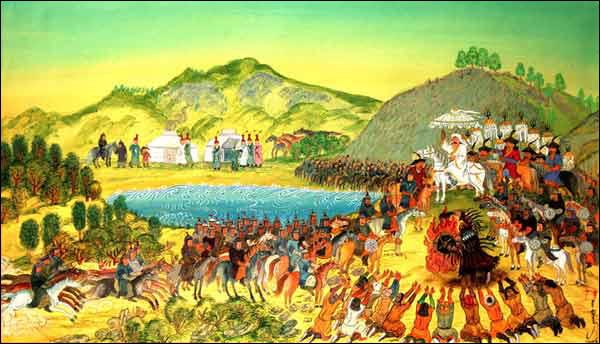
Judging by the paintings "Tsam in Urga", "Contest of Wrestlers from Ten Zasagtas", "Maidar Procession in the Monastery Sain Noyon Huree" (from the collection at the Bogd Khan Museum in Ulaanbaatar) and "The Naadam of Seven Hoshuns" and "The Maidar of Lamyn Gegeen Monastery" (from the Museum of Fine Arts), it is evident that a distinctive feature of the works by the artists of that period was the portraying of important festivities, and ceremonies like Tsam and Naadam, with crowds of people of all walks of life. The picture is teeming with lamas, clad in yellow and red robes, but somehow exaggeration and parody is felt in the way the artist treated their faces and appearance.
Among the paintings of this school, particular mention should be made of the two canvases, celebrated under the title "One Day of Mongolia" by the famous artist B. Sharav. The first painting shows the life of a fairly well-to-do Mongolian household during summer, when there is an abundance of milk and other livestock produce. Simultaneously, with a pompous feast, to the left, is depicted the uninterrupted summer labor of a rural household: milking of sheep, beating up of the fleece for making felt, castration of young animals, etc. To the right of the revelry, there is also hustle-bustle of work: lassoing of fast horses, breaking-in of a thoroughbred, milking of young mares, branding of cattle and so on.
The second canvas shows more than ten labors of mainly livestock breeders during autumn, including migration, offering of sacrifice on an ovoo, mowing of hay, making of felt, hunting, etc. The space in between is filled with figures of animals and wild beasts, solitary lamas, wanderers, pilgrims... The artist depicts the taking away of the bride from her father's house, a wedding feast, the dancing of a shaman strictly observing the sequence of developments, with a sound knowledge of national customs, attire and household utensils. His treatment of the personages is marked by profound humor and character. "Bogd Khan's Green Palace" and "Haistai Lavran" (Bogd Khan's summer palace), of the same size as the aforementioned paintings and executed in the same period, are distinguished for their manner of painting.
These paintings could be called examples of the Urga school, which to a certain extent preserved the traits peculiar to folk painting, characterized by narrative composition, completely free of the canons of Buddhist art, a comprehensible and uncomplicated manner of depiction involving concrete and lightly colored figures. In short, these four composite paintings could be defined as full-scale narratives about human life, from birth to death.
The painting school of the Mongol style, which initially was concentrated in Urga in the 20th century, soon started to spread to the provincial areas.
An example of the Mongol painting of the Urga school are the "Tsam in Urga" at the Leningrad Ethnography Museum (Russia), the painting from the Leipzig Ethnography Museum (Germany), as well as the xylographs made by artist Lodoi for Danish traveller Henning Hasslund in Khokhot and reproduced by the latter in his book "Tents in Mongolia".
Towards the dawn of the century there existed a trend toward giving an independent significance to landscape in the form of towns and monasteries. To this trend could be attributed the paintings "Urga" and "Monastery of Sain Noyon Khan Huree", by Gempiliyn Dorj and "Zayayn Huree" by an anonymous artist working in a highly distinctive realistic manner. These works were basically executed by memory, taking into account only the site of a temple in one or another aimag, its type and form in general. Therefore, they were drawn without the understanding of real architectural form, dimension and proportion, perspective and treatment of light and shade.
As a result quite often the paintings resembled blue-prints of towns as if seen from bird's eye view.
A characteristic example of this is the "Urga" by well-known artist Jugder. Its composition centres on the Gandan Monastery and the central part of Urga. The painter presented an area with a radius of more than 10 km, all the nearby mountains and rivers, the monasteries of Dambadarjaa, Dashchoinhor, Shaduvlung, situated on the two banks of the river Selbe in the north, the trade town of Naimaa to the south-east and even the Manch-jushri Monastery, located on the southern slopes of the Bogd Mountain, whereas Urga, the object of painting, is on its northern slopes. All of these are painted out on a small canvas not larger than half a square meter, with all the pilgrims, monasterial temples and premises and even the palisades around lamas' living quarters, drawn for the purpose of accurate identification.
As a result of the 1921 people's revolution the social, political and economic life in the country underwent drastic changes, which had entailed also a radical change in the artistic culture. The influence of the Soviet Union brought the style of socialist realism to Mongolia.
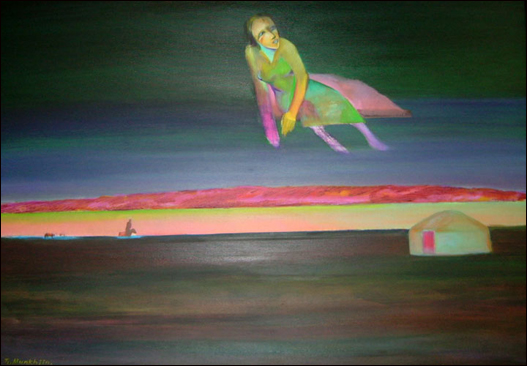
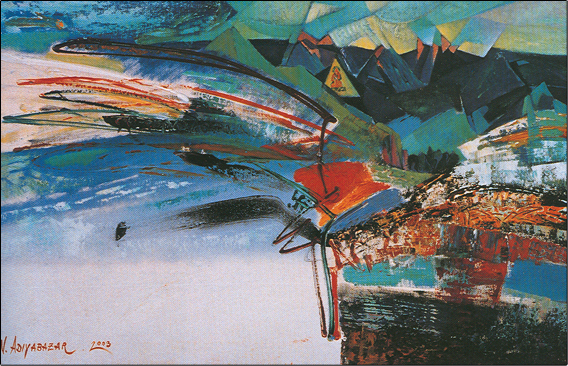
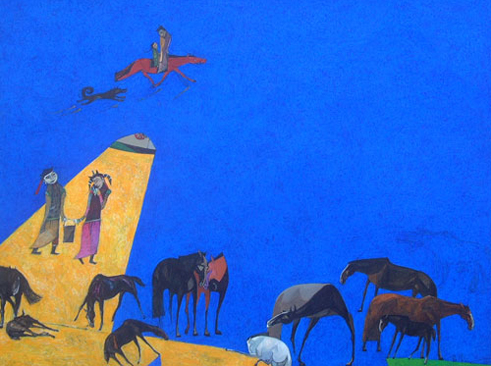
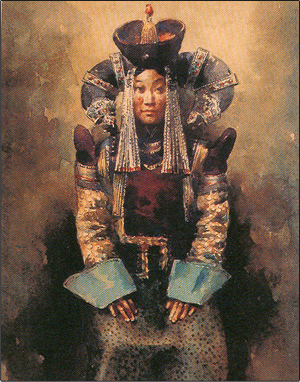
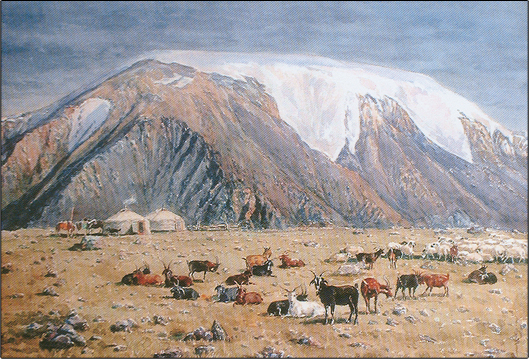
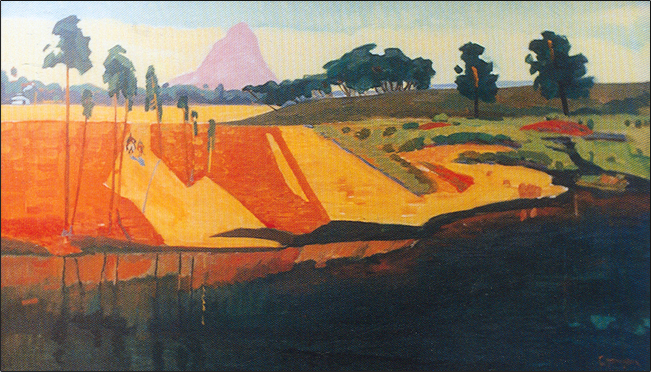
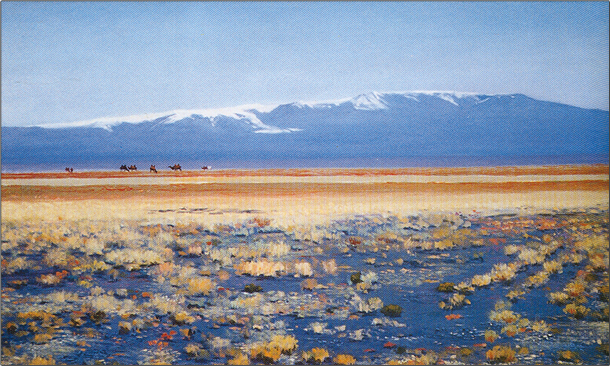
At the same time, artists continued to develop Mongolian artistic traditions. A series of portraits of Mongolian scholars, paintings such as "The Old Storyteller" by a well known contemporary artist U. Yadamsuren, "The Black Camel" by A. Sengetsohio, "Mother's Glory" by D. Damdinsuren, works by Ts. Dawaahuu devoted to an agricultural cooperative, talented productions by Ts. Minjuur, B. Avarzed, Ts. Jamsran, B. Gombosuren and other painters have been executed in this technique.
*Lang - a unit for measuring gold and silver and equivalent to 37.3 grams or an ounce
*jins - a ball, made from metal, glass or semi-precious stones (enumerated in upgrading sequence) and attached to the top of a noble's or official's cap. Signifies the degree of rank or post.
*Ovoo - a mount or cairn of rough stones where special religious ceremonies are performed in honor of the genius loci.......tries in recent years.
Naturally, there is no need to imitate, copy Mongol Zurag only as a sample of national culture, denying its movement and progress. However, while experimenting with it by way of applying the achievements of the widely popular realistic art,it is important not to change but preserve the specific qualities inherent in Mongol Zurag such as narrative composition, specific combination of colours, refinement of technique, verity of life, humour, etc.
Thus, Mongol Zurag, which was created through the efforts of many generations of folk talents and has traversed a strikingly long road of historical development, will further evolve as an organic part of contemporary Mongolian art.