People's Revolution
The Mongolian People's Republic was proclaimed and the first Constitution was adopted in 1924.
In the first half of the 1920s, the Mongolian revolutionaries pursued a prudent policy aimed at developing and strengthening a newly re-established independent state The Buddhist clergy still had a great influence on Mongolian society. After the death of Bogd Javzandamba VIII, the spiritual leader of the Mongols, the republicans took power. In 1926, the law on Separation of State and Religion was adopted. The policy to eliminate private ownership and religious freedom was chosen and implemented. By the end of the 1930s, the country was involved in the international confrontation and sided with the then Soviet Union, remaining as an autonomous but closed society until 1988.
Mongolian culture developed under the strong influences of the nomadic lifestyle and Buddhism. The Tibetan school of Buddhism was introduced during the period of the fall of Mongolian Empire and is still dominant in Mongolia.
The Mongols have used several kinds of scripts throughout their history. In the 1940s the Cyrillic alphabet was introduced as the official script and remains in use to this day. But the vertical Mongolian script is considered the national one and is being revived.
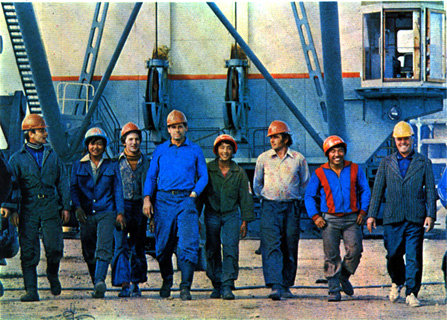
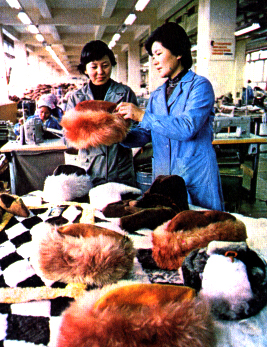
Entering peaceful construction, the MPR considerably reduced its armed forces and the released material and human resources were directed to the development of the country's productive forces. A characteristic feature of MPR postwar construction was the development of its economy on the basis of long-term planning. In December 1947 the Eleventh Party Congress approved the First Five-Year Plan (1948~1952) for the development of the national economy and culture.
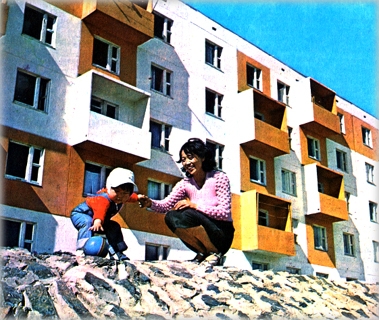
The main task of this five-year plan was to develop by all means the county's productive forces especially cattle breeding on the basis of maximum use of domestic resources, to strengthen public forms of economy, and to raise the living standards and cultural level of the people. The years of the First Five-Year Plan resulted in speeding up the growth of economic development. Expansion and reconstruction of coalmines and energy enterprises began with the construction of oil-extracting and mining projects. At the end of the 1940s the Trans-Mongolian railway linking the USSR, the MPR and China went into operation.
The Ninth Great People's Hural (February 1949) adopted a decision to relieve household units of the horse-relay service, which had for ages been a heavy burden on the arc. The horse-relay service was replaced by a state auto-relay service.
The Hural also discussed a question related to further democratization of the country’s electoral system and adopted a resolution on the introduction of universal, direct and equal suffrage by secret ballot to all organs of state power. The first election to the MPR Great People's Hural in accordance with this new electoral system was held in dune 1951.
At the first session, held in July 1951, G. Bumtsend was elected Chairman of the Presidium of the MPR Great People's Hural (from 1949 the functions of the Little Hural were transferred to the Great People's HuraI).
In October 1961, Mongolia became a member of the United Nations and in 1962 it joined the Council for Mutual Economic Assistance (CMEA).