Animals
In Mongolia, nature has preserved its virginity over vast areas. This fact, so uncommon in our age, can be explained by the relatively late onset of industrialization and the low density of the population (1.3 per sq. km), as well as by the Mongols' traditionally careful attitude to the natural environment. The latter is proven among other things by the fact that the mountain range, at the foot of which lies Mongolia's capital, was proclaimed a protected territory nearly 200 years ago.
The steppes in the east and west are splendid pastures. The grass cover is rather diverse.
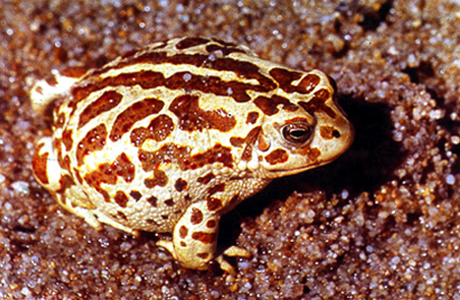
Patches of salty soil are typical of the steppe zone.
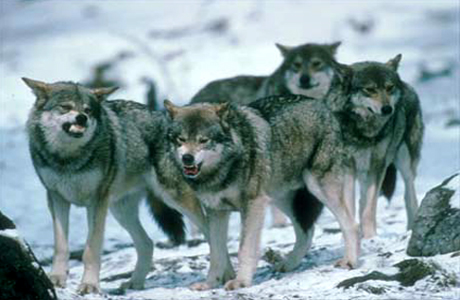
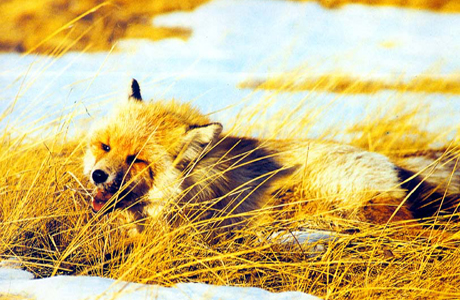
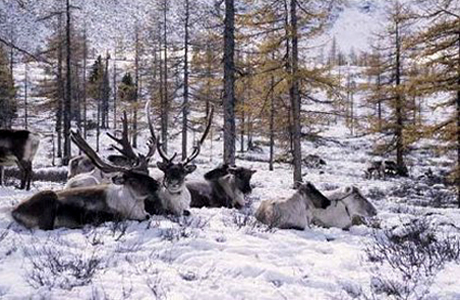
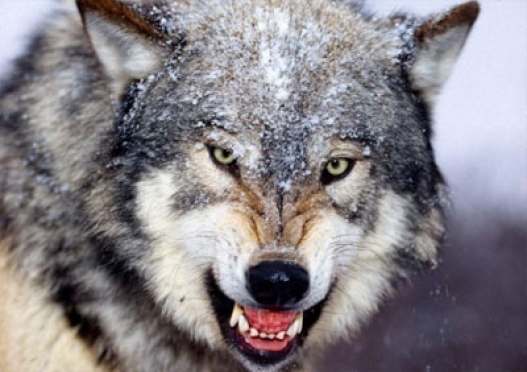
Mongolia is the habitat of 140 mammal species, 390 bird, 20 reptile and 76 fish species. In the wooded northern regions maral and roe are common, northern deer and musk deer occur less frequently while wild boar can be found everywhere. Of the fur bearing predators, glutton, fox, corsac, Iynx, ermine, Siberian weasel, and, less commonly, sable are to be found here. In the past few years, the population of wolves has shown a marked increase. Wolves invade both the steppe and the forest-steppe zones. One may come across brown bears in coniferous forests in some regions and snow leopards in the Gobi Altai.
In the steppe zone, the graceful dzeren antelope can be found. The most widespread denizen of the Mongolian steppes and plateaus is the tarbagan marmot. Its flesh is tender and highly palatable and its fur, especially that of the Altai species, is highly rated on the world market.
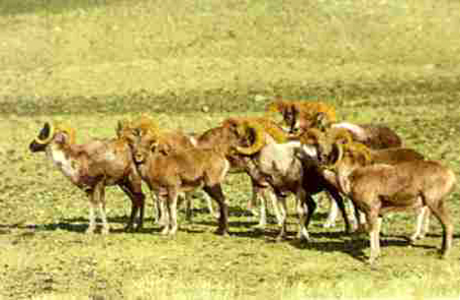
Representatives of such rare species as the khavtgai wild camel, the wild ass, the mazalai bear and the black-tailed antelope inhabit the Gobi region. In some mountain regions and in the Gobi you may come across the argali mountain ram and the yangir mountain goat.
The world of birds is rather varied. The forests are inhabited by mountain ouzel, blackbirds, wood grouse and black grouse, the rivers and lakes abound in water-fowl, including the white swan, the pelican and the cormorant. The grey crane and the bustard are common on the steppes and on the shores of the lakes. In the high altitude Altai regions the ular snow cock can be found.
The flesh of this bird has curative properties.
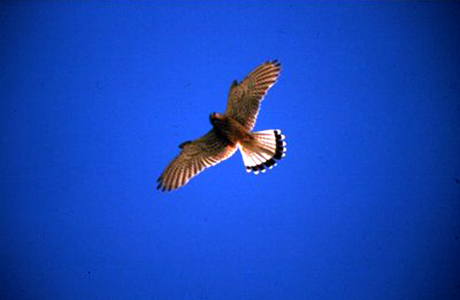
The eagle, the white-tailed sea eagle, the hawk, the falcon, the harrier and the black griffon represent birds of prey. Mongolia's rivers are a paradise for anglers. There is practically no commercial fishing in the country and the rivers and lakes teem with salmon trout, sturgeon, greenfish, grayling and other valuable fish species. Lake Khovsgol and some northern rivers abound in white salmon, while in the Balj and the Onon there are trout.
One cannot say, however, that Mongolia has no environmental problems. In 1987, the first national Red Data Book was published; a second edition was released in 1997. It provides a scientific basis for the government's nature conservation policy, listing 50 rare animal species and some 70-plant species, which are on the verge of extinction. Among the animals listed in the Red Data Book are the mazalai bear of the Gobi; the takho (Prjewalski horse); the Mongol saiga; the khavtgai wild camel, the Mongolian wild ass; the Ussuri elk; the red wolf; the irbis (snow leopard) and the Altai mountain ram. Among the protected animals are Altai onion; Mongolian guelder rose; Zaisan saxaul; Daur juniper and Mongolian adonis.
Mongolia has thirteen nature reserves. The largest one is the GreatGobi Reserve. Founded in 1975, it spreads over an area of five million hectares. Here, in this great natural laboratory, researchers watch and study Central Asian wild life.
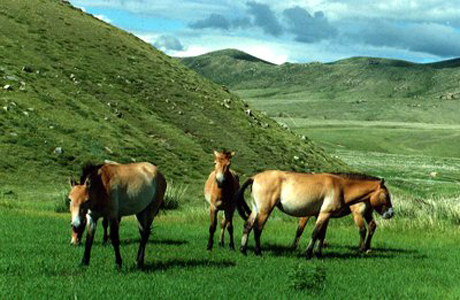
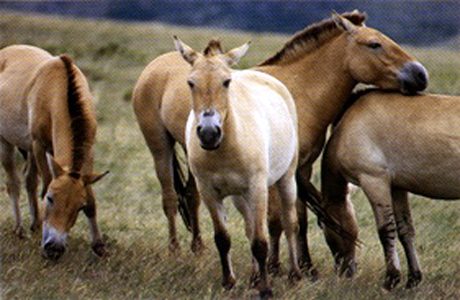
Takhi (Przewalski's horse)
Wild horses once roamed in great herds over Mongolia. Numbers declined with increasing competition for pastureland from domesticated livestock. Remnants of herds were gradually pushed into the southern Gobi -- they were discovered there by western explorers at the end of the last century. Living specimens were then exported as novelties to western zoos, where they were bred in captivity.
The Mongolian wild horse is regarded by some as a unique species, differing in important ways from other horses in the world. The subject is debated, however, and has taken on a nationalistic tinge due to the symbolic importance of the horse in Mongolia. Research is being done on the genetic makeup of the original animals, and the extent to which genetic purity was maintained during decades of captive breeding. The animals that have now been reintroduced to Mongolia are distinguished by extremely heavy manes and an unusual coloring that allows them to blend into steppe terrain. In winter, the horses are white on their bellies and light-tan colored on their backs; in summer, the light coloring darkens as snow cover on the steppe melts.
In Mongolia, this species of horse is called 'takhi,' a word that reflects a reverence for horses. Takhi means spirit, or spiritual, in Mongolian. The takhi is called the Przewalski horse in Europe and America, after a Polish colonel who explored Siberia and Mongolia for the Russian czar in the last century. Przewalski sent living examples of this horse back to St. Petersburg. European zoos then began to acquire individual horses for their collections. With the extinction of the takhi in its native Mongolia, these zoo animals became the only remaining examples of the species.
Snow Leopard
Few animals match the rare beauty and quiet mystery of the snow leopard. Seldom do people see these animals in the wild: elusive and solitary, they live in remote pockets of central Asia.
The primary threat to snow leopards is intense human population growth. This phenomenon is occurring not only in lowlands of Asia but also in high mountain areas that once were sparsely populated. In Mongolia, for example, snow leopards are finding that they must compete with humans and their livestock both for living space and for their food supply. Marmots, a staple of snow leopards' diet during the summer, are now being hunted heavily by humans for pelts, meat, and oil. (Marmots are what is known as a "buffer prey" for snow leopards: if marmots are plentiful, snow leopards are less likely to attack herders' livestock.)
In snow leopard countries there are more than 130 official 'reserves' that are believed to harbour snow leopards as well as argali sheep, black-necked cranes, wild dog, markhor, and other endangered species. Most of these, however, are reserves in name only. Few now have resources to support rangers or conservation. One urgent need is to establish corridors through which snow leopards in one threatened area can travel to other territories. Already scientists are seeing evidence of snow leopards travelling through (not living in) the lowlands of the south Gobi region of Mongolia -- an area that was once thought impossible for snow leopards.
Khulan

Herds of khulan, the wild ancestor of the domestic ass, are common in the desert and desert steppe along Mongolia's southern border with China, particularly in the Dzungarian Gobi and areas east of the protected area. Khulan, which live in herds of as many as 500 animals, can run up to 65 km per hour, easily outdistancing most predators. Although little is known about them, it is believed that khulan are expanding their range in Mongolia, though domestic livestock increasingly compete with them for pasture. The Gobi's wild ass population is the largest of four sub-populations of the Asiatic wild ass in the world, the others being in Turkmenistan and India.
Wolf
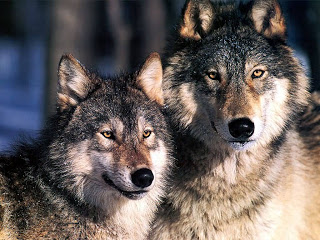
Distribution in Mongolia is considered to be the northern edge of global distribution. During the last century, common in the mountains of Altai, Khangai, Khentii, Khovsgol, Trans-Altai and south Gobi. There is information that Wild Dogs were hunted in the 1930's in the mountains of Noyon, Sevree and Nemegt (Omnogobi). In the 1940's, seen in Tsagaan Bogd, Edreng Range and Suman Khad. By the 1950's, they had disappeared from Khentii, Mongol Altai and Khovsgol. Rarely seen in the mountains of Khovsgol, southern Gobi and Trans-Altai Gobi.
Local people reported several sightings in Segs Tsagaan Bogd in 1967, and 1 fell into trap in the Gobi-Altai Mountain area, Omnogobi in 1968. An animal, which was trapped in 1969 on Zuulun Mountain, Omnogobi Province, is the last evidence of their existence in Mongolia. There have been no other reliable sightings. They may still occur in Omnogobi, Trans-Altai Gobi and mountains around Khovsgol.