Food
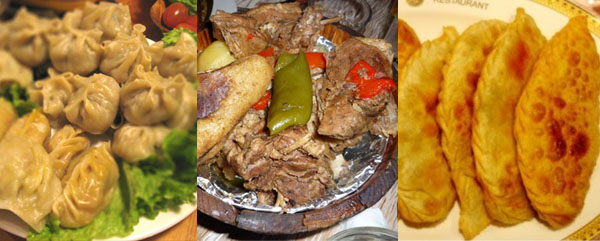
Mongolian Traditional Dishes
Presently, there are over 1800 small and medium sized business entities engaged in the food industry. Manufacturing and supply of meat, bread, beverages, flour products and salt increased.
Processing of agricultural food products and raw materials is developing in Mongolia. Currently, many small and medium factories and business entities manufacturing milk products are established in the aimag, towns and soums. This is a good start for the further development of the milk industry. However, the milk and dairy industry structure was shifted during the early years of transition to a market based economy which led to a sharp decrease in milk and dairy product production. There is a network of flour mills with a total capacity of more than 300.000 tons of flour per year. There is also a network of 8 larger grain storage facilities with a total capacity of 250.000 tons of cereals. Mongolia is producing one third of the total domestic consumption of flour. The total annual capacity of ten bigger flour factories is 163.0 thousand tons.
Meat and meat product manufacturing has an important place in the food sector and is considered to be the sector with the most potential for future development.
There are 22 medium and large slaughterhouses with a total capacity of about 62,000 tons of carcass meat per year. However, they only use 29 per cent of their total capacity. In addition, there are many smaller slaughtering facilities in the Aimag and Soum Centres. Totally, there are over 60 small and medium enterprises that produce meat products. As far as the food supply to the population is concerned, local meat production totally meets the domestic demand and some meat products are exported. Meat consumption per person has gradually increased up to 120 kilograms per year. In 2000-2003, 8 meat processing factories with an annual capacity of 60,000 tons of meat were established. At the end of 2003 11,200 tons of meat and 756 tons of by-products were exported. In the last year meat processing factories were certificated and 20 have received export licenses.
Russia is seen as the basic meat export market for Mongolia. Looking at the statistics based on the livestock number, Mongolia was able to provide domestic meat consumption and to export 19-31 thous. tons of meat in 2001-2004 years. Due to the high import customs tax of Russia, high railway transportation cost and consumer monopoly, the price of the exported meat is decreasing annually
Policy and legal framework for food and agro sector:
The main objectives of the economic policy for 2003 are to accelerate economic growth, enhance social security services and to deepen the rural development through improvements to economic and financial conditions, promotion of domestic industries with a focus on export production, while providing for sustainable recovery in the agricultural and cropping industries.
The primary objective of the food and agro-industry sector is to encourage regional and rural development to provide economic growth and to create a favourable environment for sustainable development of the food and agricultural sector. The main goals underlying the strategy for livestock sector development are (a) to provide sustainable livestock development; (b) to increase permanently the export of livestock origin products and raw materials; (c) to create for rural herders and dwellers favourable conditions for a comfortable life in their native places by improving livestock quality and breeding; (d) preventing outbreaks of infectious diseases; and (e) improving the capacity for protection against natural disasters.
In order to achieve the above mentioned objectives, the Government of Mongolia is undertaking a series of measures to deepen restructuring, support domestic industries, to address the problems and promote private sector development in the food and agricultural sector as set out in its Action Program.
The Government gives high priority to creating a favourable legal environment for food and agricultural sector development by developing relevant and appropriate laws. It also seeks to effectively use funds, materials and human resources avail-able to the sector. Finally it seeks to extend methodological and technical support to producers.