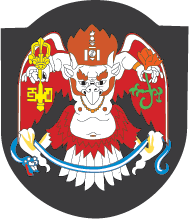
Population- 1345,3 thousand
Livestock- 331.2 thousand
Districts- 9
Ulaanbaatar was founded in 1639.
History of the City
The history of UB's foundation is closely related to political life of Mongolia in the 17th century. A Manchurian state, which arose in east of Mongolia in mid-17th century, occupied South Mongolia in 1636 and subsequently threatened to invade Khalkha and West Mongolia. In order to pursue a centralised policy of Mongolia Tusheet Khan Gombodorj /1594-1655/, the most powerful and influential Khan among Khalkha's three Khans, began a great deal of proclaiming his son Zanabazar as a religious leader of Mongolia because of the influence of Buddhism in Mongolia. Zanabazar was proclaimed by a chuulgan (meeting) of Khalkha's Khans and noyod (lords) which was held in Tsagaan nuur in 1639. Khans of Khalkha prepared for him a headquarter and gave their subjects to him as apprentices and followers. The headquarter was the base stone of former Urgu and present Ulaanbaatar. In 1654 there began building work of temples with wood, stones and bricks and the expansion of Urgu finished in 1680. Then it was renamed Ikhe Huree. But during the following 200 years Mongolia was under Manchu domination. The victory of national liberation struggle over Manchu Dynasty in 1911 affected greatly the development of the city. Because it was renamed Nyislel Huree by the Khaan's decree because the Government and Bogda Khaan's place were situated in the city. The name of Nyislel Huree was used till 1923 and it was renamed Ulaanbaatar and the capital city of the People's Republic of Mongolia at the first People's Hural of the Republic. Today's Ulaanbaatar Ulaanbaatar is situated between four mountains /Bogda Khan Uul, Chingeltei Uul, Bayanzurh Uul and Songino Khairhan/ of the Khentii mountain chains at the Altan Tevsh valley of the Tuul basin at the altitude of 1500 m above sea level /latitude 47"57` north and longitude 106"55`/. The Constitution of Mongolia said that "Ulaanbaatar is the capital city of Mongolia" and it is the country¡¯s main political, economic, industrial, scientific and cultural centre. The fact that in 1926 there were 27021 people in UB and it grew up to 645.6 thousand in 1997 and shows the importance of the city. It means that over 27.1% of the total population of Mongolia live in UB. The number of people who live in the countryside to come to Ulaanbaatar have been slightly increasing recent years. UB produced 75% of the total electricity in 1997 and 41.5% of the total domestic products of the state was done in UB. Half of the residential apartments in Mongolia is situated in UB. The population of UB has a better living condition as compared with the other parts of Mongolia. In 1970 there were 59 secondary schools with 54,000 pupils. Today the number stands at 121 schools with 134.5 thousand pupils. The number of physicians and hospital cots per persons is higher than the rest part of Mongolia. According to the statistics of 1970, there 41 physicians per 10,000 persons but the number stood at 201 per 10,000 persons in 1997. There are many theatres /opera, drama, puppet and children's/, museums /historic, natural and art galleries/ and historic monuments and sites in UB. State organisations of all levels, foreign embassies and international agencies are located in UB. They conduct their activities. New relations of socio-economics have been established and the role of the capital city in the development of Mongolia has been dramatically increasing. Taking into account the situation the State Ikh Hural adopted "Law of Mongolia on the Legal Status of the Capital City" on 5, July, 1994. There has been a considerable development in foreign relations of UB. UB has friendly relations with the following cities: Denver, CO, USA, Tokyo, Osaka and Satoro of Japan, Munich of Germany, Florence of Italy, St. Petersburg of Russia, Tiangjin of China, Ankara of Turkey and Seoul of South Korea etc.