Mongolian People's Party
Монгол Ардын Нам
Mongol Ardiin Nam
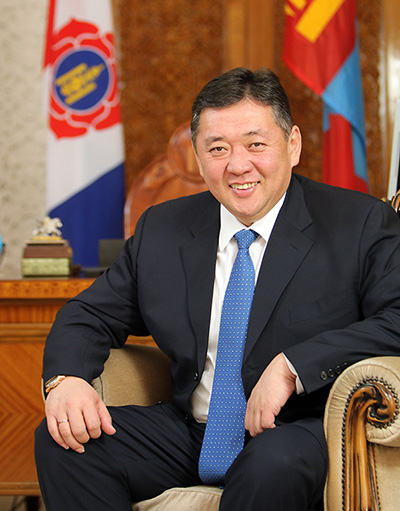
ENKHBOLD Miyegombo
Founded: June 25, 1920 (as MPRP)
Headquarters: Ulaanbaatar, Mongolia
Membership: 220,000
Ideology: Social Democracy
Political position: Centre-left
International affiliation: Progressive Alliance, Socialist International
Colors: Red and Blue
The Mongolian People's Party (Mongolian: Монгол Ардын Нам, Mongol Ardīn Nam) is the oldest political party in Mongolia. The party's ideology is currently social democracy, and was previously Marxism-Leninism. The party is abbreviated MPP in English and МАН (MAN) in (transliterated) Mongolian.
Founded in 1920, the party played an important role in the Mongolian Revolution of 1921. Following independence, it became the ruling party of one-party state Mongolia. In 1924 the party adopted the name Mongolian People's Revolutionary Party (Mongolian: Монгол Ардын Хувьсгалт Нам, Mongol Ardīn Huwĭsgalt Nam, МАХН, MAKHN), when joining the Communist International.
When in 1990 other parties became allowed, the MPP remained governing party until 1996, returning to government in 2000–2004. From 2004–2008 it was in a coalition government with Motherland–Democracy Coalition of Democratic Party and Motherland Party. In 2008-2012 it opted for another coalition government with the Democratic Party, although the MPP had a majority in parliament at that time. After the 2012 elections, the MPP became the opposition party at the parliament.
In 2010, the party reverted to its original name by dropping the word "Revolutionary", causing a breakaway faction which retained the long-standing name.
Background
1990 Democratic Revolution
In August 1984, Yumjaagiin Tsedenbal was forced into retirement in a Soviet-sponsored move, allegedly on the account of his old age and mental weakness. Jambyn Batmönkh took power in August 1984 as MPP leader as well as the country's leader.
On 10 December 1989, the first open pro-democracy demonstration met in front of the Youth Cultural Center in Ulaanbaatar. In the subsequent months, the demonstration organizer activists founded Mongoliin Ardchilsan Kholboo (Mongolian Democratic Union) and continued to organize demonstrations, rallies, protests and hunger strikes, as well as teachers' and workers' strikes calling for democracy both in the capital and the countryside and had growing support from Mongolians all over the country.
On March 7, 1990, in Sükhbaatar Square, Mongolian Democratic Union launched a hunger strike urging the communists to resign. The party's Politburo – the authority of the government – eventually gave way to the pressure and entered negotiations with the leaders of the democratic movement. Jambyn Batmönkh, chairman of Politburo of MPRP's Central Committee decided to dissolve the Politburo and to resign on 9 March 1990. This paved the way for the first multi-party elections in Mongolia.
Behind the scenes, however, the Party had seriously considered cracking down on the protesters, writing a decree that was left to be signed by the party leader Jambyn Batmönkh. Batmönkh opposed it, maintaining a strict policy of never using force (Mongolian: Хэрхэвч Хүч хэрэглэж болохгүй). People those present later recalled that Batmönkh said "I will never sign this. We few Mongols have not yet come to the point that we will make each other's noses bleed," smacked the table, and left the room."
In the elections of 1990, parties had run for 430 seats in the Great Khural. Opposition parties had been unable to nominate enough candidates. The MPRP won 357 seats in the Great Khural, won a majority in the Small Khural as well (which was later to be abolished), winning 31 out of 53. Nonetheless, the new MPRP government under Dashiin Byambasüren shared power with the democrats, and implemented constitutional and economic reforms, with a new constitution being adopted in 1992. With the collapse of the Soviet Union, which had until 1990 provided significant economic aid to Mongolia's state budget, the country experienced harsh economic problems. In the 1993 Mongolian presidential elections, the MPRP was defeated for the first time in its history, with the candidate backed by the democratic parties, Punsalmaagiin Ochirbat, winning with two thirds of the vote.
In 1996 parliamentary elections, Democratic Union Coalition co-led by Tsakhiagiin Elbegdorj as chairman of Democratic Party won. This time the democrats won the legislative elections for the first time. In 2000, 2004, and 2008, the MPRP won the legislative elections and was the ruling party between these periods. It formed two coalition governments with Democratic Party in 2004-2008 and 2008-2012.
In 2003, the party became a member of the Socialist International.
The 2008 Parliamentary elections were especially controversial, with the MPRP being accused of vote rigging. Protests against the results turned violent on 1 July, and ensued riot. Not enough measures to stop the riot or extinguish the fire were taken by the authorities. The scene of the riots was the MPRP headquarters, which was burnt out. Following the riots, a five-day state of emergency was declared by President Nambaryn Enkhbayar, the first time in Mongolia. Five people, all of them civilians, were killed during the state of emergency: four were shot, and one apparently died from carbon monoxide poisoning. The Mongolian Minister of Justice estimated 220 civilians and 108 service members were injured. With the situation tense, the MPRP decided to admit the Democratic Party into government, forming a coalition. With its headquarters burnt, the MPRP tore down the building and built a new much taller and bigger modern headquarters in its place (named the Independence Palace, Mongolian: Тусгаар тогтнолын ордон) with subsidiary from the budget of the government run by the Mongolian People's Party (former MPRP) and donations from its party members and the building began to fully operate on 26 November 2011.
In 2009 Mongolian Presidential election, Democratic Party candidate Tsakhiagiin Elbegdorj defeated MPRP candidate incumbent President Nambaryn Enkhbayar. In January 2012, Democratic Party made a decision to leave the coalition government before upcoming parliamentary elections in June. In 2012 Parliamentary elections Democratic Party defeated MPP and MPP became the opposition with 26 seats at the parliament. In 2012 local elections of the capital city, provinces, districts MPP was defeated for the first time in the country's history. In 2013 Mongolian Presidential election, Democratic Party candidate incumbent President Tsakhiagiin Elbegdorj defeated the MPP candidate.
In 2016, the MPP came back into power, winning an 85 percent majority of the seats in parliament. Prime Minister Chimed Saikhanbileg and parliament chairman Zandaakhuu Enkhbold were unseated. The MPP's Jargaltulga Erdenebat was elected to succeed Saikhanbileg.